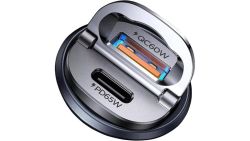
High‑Watt USB‑C Car Chargers That Keep Your Phone Charged

Introducing Maria, our meticulous planner and talented visual storyteller. She has a knack for discovering those hidden gems, chic boutique spots, and charming little cafes that add a touch of elegance to every journey. With her keen eye for photography and her passion for travel, Maria will transport you to the most enchanting corners of the world, inspiring you to explore new places, one picture-perfect destination at a time.
Want a car charger that keeps your phone charged? Choose a high‑watt USB‑C unit. The MRGLAS 125W model offers 65W PD and 60W QC, while its 200W Dual‑PD gives two 100W USB‑C and a 60W USB‑A slot, supporting PCC, SCP, FCP. Anker’s 167.5W 3‑port pack provides 100W, 45W USB‑C, and 22.5W USB‑A, and UGREEN’s 130W charger delivers 85W for iPhone/PPC plus a 45W PPS port. Explore our guide today for the best fit, you’ll learn.
Key Takeaways
- Opt for 100 W or higher USB‑C PD outputs; a 100 W port can keep a flagship phone topped up while driving.
- Dual‑port chargers (two 100 W USB‑C + 60 W QC) let you charge a phone and a laptop simultaneously without draining the onboard battery.
- Look for chargers that support PPS/PQC 4.0/3.0; these protocols deliver power efficiently, minimizing heat while maintaining fast charge rates.
- Safety comes standard: dual‑core chips, built‑in over‑current/temperature protection, and UL/CE/FCC certifications prevent overheating and short‑circuits.
- Compact, all‑metal designs with a pull‑ring for quick removal keep chargers handy and reduce bulk in the car’s console.
MRGLAS 125W All-Metal USB-C Car Charger

If you’re a commuter, a road‑tripping techie, or just someone who routinely has several high‑end devices in the backseat, the MRGLAS 125W All‑Metal USB‑C Car Charger is built for you. Its compact 2.76×2.28×1.02‑inch metal body fits any cigarette‑lighter socket, staying flush with the dash. Inside, 125W splits into a 65W PD USB‑C and a 60W QC USB‑A port, both safe thanks to a heat‑sinked chassis. A dual‑core smart chip keeps over‑current, short circuits, and heat spikes at bay, while adaptive algorithms let an iPhone 17 Pro Max jump from 0 % to 90 % in 30 minutes. Two‑year warranty and a pull‑ring for instant removal.
Best For: commuters, road‑tripping tech enthusiasts, and anyone who needs to power multiple high‑end devices on the go.
Pros:
- 125 W total output split across 65 W PD USB‑C and 60 W QC USB‑A for simultaneous fast charging.
- All‑metal, heat‑sinked chassis stays cool and sits flush in any cigarette‑lighter socket.
- Dual‑core smart safety chip guards against over‑current, short circuits, overheating, and other hazards.
Cons:
- Slightly larger than single‑port chargers, adding minimal bulk to the dash.
- Only two ports, so you can’t charge more than two devices at once.
- Requires a car outlet with enough amperage to tap the full 125 W.
https://www.amazon.com/dp/B0C53MKFMY
USB-C 200W Dual PD Car Charger

For mobile power warriors who can’t miss a beat, the USB‑C 200W Dual PD Car Charger pumps out 200 W total—split as two 100‑W Type‑C ports and a 60‑W USB‑A port—so you can charge a MacBook, notebook, or iPad Pro while on the road.
It supports QC 4.0, QC 3.0, PD 3.0, PPS, and more, delivering lightning‑fast power for laptops, phones, and consoles. The 12 V–24 V input range keeps it versatile, while a heat‑sensing system prevents overheating. Over‑current, voltage, and temperature safeguards, plus a start‑trickle mode protect battery health. Compact—1.8 × 1.8 × 3 in, 2.89 oz—features ice‑blue LED glow and UL, CE, FCC, RoHS certs, with 24‑hour support, right now.
Best For: versatile mobile power users—laptop owners, gamers, and multitasking professionals who need fast, multi‑port charging on the go.
Pros:
- 200 W total output (100 W × 2 Type‑C + 60 W USB‑A) handles laptops, tablets, and gaming consoles simultaneously.
- Extensive protocol support (PD 3.0, QC 4.0/3.0, PPS, SCP/FCP) ensures compatibility with almost every modern device.
- Built‑in heat‑sensing, over‑current, over‑voltage, and temperature safeguards, plus start‑trickle mode, protect battery health and keep the charger safe.
Cons:
- Requires a 12 V–24 V input range, limiting use only to vehicles with appropriate power output.
- 200 W output may be overkill for simple phone charging, adding unnecessary bulk.
- Manual weight and size (~2.89 oz, 1.8 × 1.8 × 3 in) can be heavy/large compared to single‑port chargers, potentially cluttering a car’s interior.
https://www.amazon.com/dp/B0CYQ9JM3L
Anker 167.5W 3-Port USB‑C Car Charger

Need a single charger that keeps your MacBook Pro, iPhone, and accessories topped up on the road? The Anker 167.5W 3‑port USB‑C car charger delivers that power. It offers a 100 W USB‑C port that tops a 16‑inch MacBook Pro from 0 % to 50 % in 47 minutes, a 45 W USB‑C port for iPhones, Samsung phones, and tablets, and a 22.5 W USB‑A port for AirPods and other gear. Compact at 0.04×0.04×0.04 in. and 1.76 oz., it slides in car. Includes a 3.3‑ft USB‑C cable, quick‑start guide, and an 18‑month warranty. You’ll appreciate reliable power on long drives, and Anker’s 18‑month warranty gives peace of mind.
Best For: Travelers and tech enthusiasts who need to keep a MacBook Pro, smartphone, and accessories charged simultaneously on the go.
Pros:
- 167.5 W total power in a single, compact unit
- Dedicated 100 W USB‑C port for fast MacBook Pro charging
- Includes a cable, quick‑start guide, and an 18‑month warranty
Cons:
- 3.3‑ft cable can be limiting on longer trips
- The 45 W USB‑C port may not support the newest, higher‑capacity phones
- Unit is still a single charger – alternatives with separate chargers may be lighter overall
https://www.amazon.com/dp/B0CZ7BL16W
Anker 40W USB‑C Car Charger Duo

You’ll love the Anker 40W USB‑C Car Charger Duo if you’re a tech‑savvy commuter who needs to power multiple USB‑C devices on a single plug. The PowerDrive III Duo delivers 40 W total, split across two ports, and uses PowerIQ 3.0 plus Power Delivery 3.0 to charge phones, tablets, AirPods, and more quickly. Its 2.7 × 1.41 × 1.41‑inch footprint and 1.12‑oz weight keep your dashboard clutter‑free. The charger ships with an 18‑month warranty and a user guide, plus a dedicated support line for any questions. In the box, you’ll find the charger, guide, and warranty card, plus a link to online details at your fingertips.
Best For: tech‑savvy commuters who want to quickly charge multiple USB‑C devices from a single car plug without cluttering the dashboard.
Pros:
- 40 W total output split across two USB‑C ports, enabling fast charging of phones, tablets, and AirPods with PowerIQ 3.0 + Power Delivery 3.0.
- Ultra‑compact 2.7 × 1.41 × 1.41‑inch design and 1.12‑oz weight keep your dashboard free of excess bulk.
- 18‑month warranty and dedicated customer support line provide long‑term peace of mind.
Cons:
- Lacks USB‑A ports, so older devices that do not support USB‑C cannot be charged.
- Split power may limit simultaneous high‑power charging of two large devices.
- Tiny footprint can result in a loose fit in some vehicle outlets, requiring a secure mounting accessory.
https://www.amazon.com/dp/B0843SCLYH
UGREEN 130W USB-C Car Charger for iPhone

The 130‑watt UGREEN USB‑C car charger is ideal for power‑hungry users who need to top up several high‑consumption gadgets—especially iPhone, iPad, and MacBook—while on the road. It plugs straight into any standard 12 V or 24 V cigarette‑lighter socket that’s clear of dust, making it a universal fit for most cars. With 130 W total output, you can charge multiple devices at once—your iPhone, tablet, or even a MacBook—with the fast 45 W PPS port dedicated to newer smartphones. The charger’s safety IC monitors overheating, short‑circuit, and over‑current; a blue LED gives status, and its 3.06 in × 1.4 in × 0.94 in size keeps it lightweight at 1.59 oz.
Best For: travelers and power‑hungry users who need to fast‑charge an iPhone, iPad, or MacBook alongside other gadgets while on the road.
Pros:
- 130 W total output with a dedicated 45 W PPS port for the latest smartphones, keeping charge times minimal.
- Compact 3.06 in × 1.4 in × 0.94 in design and only 1.59 oz weight makes it easy to slip into any vehicle’s cigarette‑lighter socket.
- Built‑in safety IC protects against overheating, short‑circuit, over‑voltage, and over‑current, with a blue LED indicator for real‑time status.
Cons:
- Limited to one high‑power USB‑C PPS port, requiring additional USB‑A or 3‑USB‑C arrangements for multiple devices.
- Requires a clean 12 V/24 V socket; dust or debris can impede proper contact and reduce power transfer.
- The 45 W PPS capability is geared toward newer Android phones; older iPhones or non‑PPS devices do not get full 45 W, limiting speed.
https://www.amazon.com/dp/B0B3D9XW8X
UGREEN 130W USB‑C Car Charger (100W+30W)

For power‑hungry commuters and digital nomads who need to keep multiple high‑demand devices alive on the road, the UGREEN 130W USB‑C car charger delivers a combined 130 W: a 100 W PD port plus a second 30 W PD port, so you can fast‑charge a MacBook, iPhone, or Steam Deck at the same time.
The charger includes a 3.3‑ft USB‑C cable, an E‑Marker Chip for Power Delivery, and UL, RoHS, CE, FCC certification. Its body resists scratches, a blue LED lights the status at night, and the 3.07×0.94×1.42‑inch, 1.59‑oz design fits most 12‑24‑V sockets, delivering power for laptops, phones, drones, and more.
Best For: Power‑hungry commuters and digital nomads who need to fast‑charge a laptop, phone, and an accessory all at once while on the road.
Pros:
- 130 W total output (100 W + 30 W) lets you charge a MacBook and an iPhone simultaneously.
- Includes a 3.3‑ft USB‑C cable and E‑Marker chip for safe PD delivery.
- UL, RoHS, CE, FCC certified with over‑charge, short‑circuit, and overheating protection, plus a blue LED status indicator.
Cons:
- Only two USB‑C PD ports; no USB‑A or multi‑port flexibility.
- No dedicated port for lower‑powered devices (e.g., tablets) besides the 30 W PD port.
- Slightly higher price for the compact design compared to basic single‑port chargers.
https://www.amazon.com/dp/B0B3CSLPZR
JOYROOM 175W 3-Port USB-C Car Charger

Elevating your road trips, the Joyroom 175 W charger splits 120 W of USB‑C output across two ports, letting you power a laptop, tablet, and phone at once without sacrificing speed. Its three independent chips deliver 100 W and 45 W PD, plus a 30 W QC USB‑A port, so devices charge fast and simultaneously. A 4‑ft cable with an E‑Mark chip guarantees safe transfer, while a multi‑color LED light adds style in low light. Built for 12 V–24 V vehicles, it’s UL, CE, FCC, and ROHS certified, featuring heat‑suppressing vents and protections against overcurrent, voltage, and shorts. Compact, it fits easily on any modern dashboard.
Best For: travelers, mobile workers, or families who need to charge multiple high‑power devices (laptops, tablets, phones) simultaneously during long drives.
Pros:
- Provides 175 W total output with 100 W + 45 W PD ports and 30 W QC USB‑A, allowing rapid, simultaneous charging of a laptop, tablet, and phone.
- Built‑in 4‑ft USB‑C cable with E‑Mark chip ensures safe, fast delivery and saves space on the dashboard.
- Certified UL, CE, FCC, and ROHS, with heat‑suppressing vents and comprehensive overcurrent/overvoltage protections for reliable safety.
Cons:
- Requires separate cables if you want to use devices other than those supported by the built‑in cables (e.g., Lightning or USB‑B).
- Higher upfront cost compared to simpler 2‑port chargers.
- The LED ambient light may be too bright or distracting for some users in low‑light conditions.
https://www.amazon.com/dp/B0C3B51KDJ
Anker 323 USB-C Car Charger, 52.5W

If you’re on the road with a premium phone and a tablet, the Anker 323 52.5 W car charger offers the quickest, safest power you’ll get on a single outlet. Its compact black design measures just 2.2 by 1.18 inches, weighs 0.847 oz, and fits effortlessly into your cup holder or console slot. The dual‑port setup delivers up to 30 W through USB‑C and 22.5 W via USB‑A, letting you charge an iPhone and an Android tablet at once. PowerIQ 3.0 instantly balances voltage and current to match each device’s needs, while ActiveShield 2.0 monitors temperature, trimming output when hot, enjoy peace and reliable support.
Best For: drivers who need fast, simultaneous charging for premium phones and tablets while on the go.
Pros:
- Dual ports deliver up to 30 W USB‑C and 22.5 W USB‑A for simultaneous fast charging of phone and tablet.
- PowerIQ 3.0 and ActiveShield 2.0 automatically adjust voltage/current and monitor temperature for optimal, safe charging.
- Ultra‑compact size (2.2″ × 1.18″) and ultra‑lightweight (0.847 oz) fit easily in any cup holder or console slot.
Cons:
- Single 52.5 W output limits total power; may not satisfy multiple high‑draw devices simultaneously.
- USB‑C port tops out at 30 W, insufficient for charging larger laptops or power‑hungry peripherals.
- 18‑month warranty is shorter than some competitors that offer two‑year coverage.
https://www.amazon.com/dp/B0BPH6S4DN
CHIPOFY 300W 6‑Port USB‑C Car Charger

The CHIPOFY 300W 6‑Port USB‑C Car Charger delivers an astounding 300 W peak output, making it the go‑to power hub for anyone who’s on the road with a laptop and several phones.
You get four USB‑C ports powering up to 140 W on C2, plus two 60 W QC 3.0 USB‑A slots—every port can charge simultaneously.
The 140 W USB‑C2 delivers 0‑80 % of a 16‑inch MacBook Pro in just 30 minutes, thanks to PD 3.1/3.0 and PPS protocols.
It supports dozens of laptops, phones, and tablets—iPads, Nintendo Switch, and even the latest iPhone 16/15 Pro Max handling each device’s DC‑power needs automatically.
It’s fire‑resistant, auto‑heat safe, ultra‑compact, only 3.39 oz.
Best For: travelers who need to charge a laptop and multiple phones or tablets at once while on the road.
Pros:
- 300 W peak total output with a 140 W USB‑C port capable of fast‑charging a MacBook Pro 16‑inch in just 30 min.
- Six ports all work simultaneously, plus auto‑detect & smart IC tuning for optimal device charging.
- Compact, lightweight (3.39 oz), fire‑resistant and heat‑managed design for safe in‑vehicle use.
Cons:
- Higher price point compared to standard car chargers.
- Limited to six ports; won’t accommodate more devices without a separate adapter.
- Requires a vehicle’s 12 V outlet; not suitable for power sources that don’t support high‑current 300 W output.
https://www.amazon.com/dp/B0F8HTMTLV
LISEN 170W USB‑C Car Charger for Phones

For power‑hungry travelers who need to keep a MacBook or iPhone 17 Pro Max charged on the go, the LISEN 170W USB‑C Car Charger delivers lightning‑fast, 140‑W power from one of its three ports. The remaining two ports provide 30 W each—one USB‑C and one USB‑A—supporting quick power for devices like AirPods or smartwatches. Thanks to PD 3.1, QC 4.0, and PPS, it adjusts output intelligently. Its GaN core keeps heat low and efficiency high, even under full load. A full‑metal shell plus heat‑dissipating design guarantees durability. A subtle LED keeps ports visible in darkness, and the included 240 W USB‑C‑to‑C cable lets you charge two devices simultaneously. UL, FCC, and CE certificates guarantee safety, while a year’s warranty covers you. Available from March 4 2024, the LISEN 2E7112 packs power without bulk for every charging need on road.
Best For: travelers and professionals who need rapid, reliable charging for laptops and high‑end smartphones on the go.
Pros:
- 170 W total output with a powerful 140 W USB‑C port that can fully charge a MacBook in ~30 min.
- Dual 30 W ports (USB‑C & USB‑A) allow simultaneous charging of devices like AirPods or smartwatches.
- GaN tech and heat‑dissipating, full‑metal chassis keep the charger cool and durable while maintaining efficiency.
Cons:
- The 140 W port may be excessive for most smartphones, making the extra power underutilized.
- Only three ports could limit usage if you have more than two devices to charge at once.
- The included cable is 240 W rated but may not support the highest power levels with certain adapters.
https://www.amazon.com/dp/B0CX1W5W41
Anker 67W 3-Port USB-C Car Charger

Need to power a MacBook Pro, a Galaxy S series phone, and a tablet all at once without hauling a bulky set‑up? The Anker 535 67W car charger does just that. With three ports—45 W, 22 W, and 15 W—it handles a MacBook Pro 14, a Galaxy S‑series, and an iPad while on the road. It comes only 2.36 × 1.26 × 1.26 in and weighs 1.12 oz, so fits in any cup holder. ActiveShield 2.0 monitors heat and adjusts output, giving you safety and peace of mind. Loved by 3,623 reviewers, it holds a 4.8‑star rating and is backed by an 18‑month warranty. It powers every device on the go today.
Best For: travelers who need to charge a MacBook Pro, a Galaxy S series phone, and a tablet simultaneously without extra cables.
Pros:
- Ultra‑compact design that fits easily in any cup holder.
- Fast, multi‑port charging with a dedicated 45 W USB‑C port for laptops.
- Built‑in ActiveShield 2.0 safeguards against overheating.
Cons:
- 15 W USB‑A port may be too weak for fast charging a standard smartphone.
- Only one 22 W USB‑C port, limiting the number of high‑power devices charged at once.
- No USB‑C to HDMI or other output options for connecting external displays.
https://www.amazon.com/dp/B0BSVB93DK
140W USB-C Car Charger for iPhone, Laptop

Ever wonder why a 140‑W USB‑C car charger feels like a game‑changer on the road? You’ll love its single port blasting 140 W, plus a second port that still delivers 45 W. With PD 3.1, PPS, QC 4.0, QC 3.0, and AFC, it instantly finds the best profile. Three protection chips keep your laptop and phone safe, while its 207.5 W total output keeps multiple devices alive. Designed for 12‑to 24‑V sockets, it feels solid—ABS housing, heat holes, and a built‑in fuel‑pump cooling system. Packed with a 3.3‑ft cable, this charger runs out of the car, not the battery. Stay powered, productive, and travel smarter.
Best For: travelers and commuters who need to charge laptops and smartphones simultaneously while keeping the vehicle battery healthy on long drives.
Pros:
- 140 W single port plus a 45 W second port delivers a combined 207.5 W of output.
- Built‑in UL certification, three independent protection chips, and adaptive current reduction keep devices safe.
- Compact 2.7 oz design with a durable ABS housing, heat‑dumping holes, and a 3.3‑ft reinforced cable.
Cons:
- Only two USB‑C ports (no USB‑A), which limits device compatibility.
- Requires a 12 V–24 V vehicle socket; not suitable for older vehicles lacking that range.
- The 140 W port may be overkill for devices that don’t support high‑power charging, reducing overall practicality for some users.
https://www.amazon.com/dp/B0F8QWX55C
90W Dual 45W USB-C Car Charger 2 Pack

If you’re chasing quick power for both a phone and a tablet while on the road, the W Dual 45W USB‑C Car Charger 2 Pack delivers that with two 45‑W PD ports that can crank two devices from 0 % to 60 % in just 30 minutes. You’ll plug the compact 5.55 × 4.65 × 1.61‑inch chargers into any 12‑V vehicle socket, and the included 3.3‑ft Type‑C cables make setup instantly. Both units share one 12‑V adapter, granting 90 W of total output—each port delivers 45 W to power phones, tablets. UL 2089‑approved strongly protects against over‑current, over‑charging, overheating, auto‑shutdown, showing soft‑blue LED brightly.
Best For: travelers and commuters who need to charge both a phone and a tablet simultaneously on the go.
Pros:
- Dual 45 W PD ports deliver rapid charging for two devices at once.
- Compact, lightweight design fits easily into any 12‑V vehicle socket.
- UL 2089‑approved safety features protect against over‑current, over‑charging, and overheating, with auto‑shutdown and a soft‑blue LED indicator.
Cons:
- Includes only USB‑C cables; Lightning‑cable users must buy a separate adapter.
- Lacks USB‑A ports or multi‑port options for other devices.
- High output (90 W total) can pull significant power from the vehicle’s battery, potentially affecting power availability in demanding driving conditions.
https://www.amazon.com/dp/B0D2HXYPNM
67W 3-Port Fast USB-C Car Charger & Cable

Looking for a charger that lets you keep every device—from iPhone and iPad to MacBook Air and Androids—charged at once? The 67 W 3‑Port Fast USB‑C Car Charger & Cable outputs 37 W to a USB‑C and 30 W to a USB‑A, bringing your iPhone or Samsung from 0 % to 50 % in about thirty minutes while also boosting a MacBook Air or iPad fast. Smart safety chips guard against over‑current, over‑voltage, and short‑circuits, and an ABS + PC shell shields both device and charger. The lightweight package launches with a 3‑ft cable, for daily commutes and road trips, and a two‑year warranty.
Best For: Busy commuters and travelers who need to power multiple Apple and Android devices simultaneously on the go.
Pros:
- 67 W total output (37 W USB‑C + 30 W USB‑A) lets you fast‑charge iPhone, iPad, MacBook Air, and Samsung phones at the same time.
- Built‑in intelligent safety chip and ABS + PC shell protect both your devices and the charger from over‑current, over‑voltage, and short‑circuit faults.
- Lightweight design with a 3‑ft USB‑C cable and a 2‑year warranty makes it ideal for everyday commutes and road trips.
Cons:
- Total power is limited to 67 W, which may not be enough for charging larger laptops or multiple high‑draw devices simultaneously.
- Only one USB‑C port limits the ability to charge two USB‑C devices at once.
- The 3‑ft cable may be too short for some users who prefer a longer reach or a detachable cable.
https://www.amazon.com/dp/B0DHQB6WQR
MRGLAS 90W USB-C Car Charger with PD45W QC45W

With a total 90 W output, the MRGLAS K97 lets you fast‑charge both USB‑C and USB‑A devices—ideal for keeping a phone, tablet, and laptop powered while you drive.
You’ll notice it’s the smallest cigarette‑lighter charger on market, fitting flush without blocking doors or vents.
Its all‑metal housing dissipates heat, resists scratches, and the pull‑ring lets you yank it out in seconds.
When you plug in, the twin PD45W and QC45W cores fast‑charge devices to 89 % in thirty minutes and come with a 3.3‑ft nylon cable.
It’s built with a 100,000‑bend cable and a two‑year warranty, and chip shields against heat.
Best For: travelers and everyday drivers who need a compact, dual‑port charger to keep phones, tablets, and laptops powered without taking up precious dashboard space.
Pros:
- Extremely slim, flush‑fit design is the smallest cigarette‑lighter charger on the market, freeing up door and vent space.
- Dual PD45 W / QC45 W cores deliver up to 90 W total, letting you fast‑charge both USB‑C and USB‑A devices simultaneously.
- Fully‑black all‑metal housing and a break‑resistant 3.3‑ft nylon cable provide excellent heat dissipation, durability, and a 100 000‑bend lifespan.
Cons:
- Lacks a higher‑power (100 W) port for currently popular gaming laptops and 4K monitors.
- The premium all‑metal design adds a slight cost premium compared to plastic alternatives.
- No integrated power monitor or USB‑C pass‑through to charge an additional device while the charger remains plugged into the car.
https://www.amazon.com/dp/B0C898NRWL
Factors to Consider When Choosing a USB‑C Car Charger (High Watt)
When picking a high‑watt USB‑C car charger, you’ll want to check that the power output matches your devices’ needs, so faster charging feels seamless. Make sure the charger supports your specific devices and carries safety certifications like UL or CE to guard against over‑current and short circuits. Finally, look at its heat management and port layout—more ports give you flexibility, but good cooling keeps both charger and phones safe.
Power Output Level
How much power do you really need to keep a laptop, a phone, and a tablet running on the go? If you want a laptop to stay charged, aim for a charger that delivers at least 100 W on a USB‑C port. Smartphones benefit from 60 W on USB‑A. A 200‑W unit that offers two 100‑W USB‑C sockets lets you power a laptop and a tablet without cutting power. Remember that a 125‑W output draws under 10 A from a 12‑V outlet, staying below the typical 12‑A limit. When you’ll plug in multiple devices, pick a charger whose total wattage tops their combined peak—for instance, a 170‑W charger can push 120 W, 45 W, and 5 W at once. Advanced PD 3.1 pushes single ports to 140 W, outpacing older PD 3.0 limits.
Device Compatibility
Because you’ll be powering a mix of laptops, phones, and accessories, choosing a charger that recognizes each device’s power profile is key.
You’ll want USB‑C PD 3.0 ports that output up to 100 W, so your MacBook Pro 16‑inch, Windows notebooks, and Chromebooks charge and safely. A separate USB‑A port with QC 4.0 gives simultaneous 30 W fast charging for most smartphones, including every iPhone and Android phone that supports Quick Charge. Automatic device‑profile detection lets the charger switch between 45 W PD, 60 W QC, and PPS modes, matching iPhones, Samsung Galaxy S24‑S22 series, and Google Pixel 8. The 12 V – 24 V input range covers almost every car, SUV, and truck, delivering reliable power to tablets, handheld consoles, and dash‑cams. PPS‑capable USB‑C ports adjust voltage precisely—9 V @ 5 A or 12 V @ 3 A—for efficient performance speed and battery longevity.
Safety Certifications
If you want peace of mind while driving, the charger’s certifications should come first. Look for UL, CE, FCC, and RoHS stamps, proving the unit meets strict electrical, electromagnetic, and environmental standards. Reputable models also carry IEC 62368‑1 approval, the industry’s unified safety framework for IT and consumer electronics. Inside, check that the charger packs over‑current, over‑voltage, short‑circuit, and temperature protection, with fail‑safe interlocks that cut power on fault detection. Documents such as test reports and conformity certificates should reveal compliance with ISO 9001 quality management and ISO 14001 environmental management, ensuring consistent production and safety performance. These layers of certification give you confidence your car charger will stay safe and reliable on every trip, and keep your devices protected during long drives and enjoy uninterrupted charging.
Heat Management
Once you confirm that your charger carries UL, CE, FCC, and RoHS stamps, the next factor that can affect performance and safety is its thermal design.
Choose today a charger with all‑metal chassis and vent‑mounted heat‑sink fins. These fins pull heat from 125 W circuitry while keeping junctions below 85 °C during long drives. Vehicle‑airflow venting—side slots exposed to combustion‑air—cuts power load. A dual‑core IC monitors junction temperatures (≈80 °C for the controller, 90 °C for the power transistor) and throttles or shuts the unit when limits are reached. Heat‑spreadable cable feed‑throughs of aluminum or copper move excess heat from the USB‑C port to chassis, preventing hotspots. Now, in multi‑port models, staggered power allocation or active thermal balancing caps each port to ~45 W, keeping heat close to 20 W.
Port Count & Layout
Choosing the right port count and layout is essential if you want a charger that can handle both a laptop and a phone at once. With at least two USB‑C ports, you keep your laptop running at full speed (e.g., 100 W) while your phone stays charged (e.g., 45 W). A single USB‑C forces a tug‑of‑war, throttling the laptop to the charger’s lower ceiling. Adding a dedicated USB‑A Quick Charge port (30–60 W) gives you a legacy‑phone fallback without sacrificing laptop juice. Make sure the total output (say, 200 W) splits wisely among ports; otherwise one gets starved. Finally, match the layout to your gear mix—two high‑power USB‑Cs if you’re laptop‑centric, or a 100 W USB‑C plus 60 W USB‑A for mixed use. This balance guarantees every device receives adequate power, boosting charging efficiency.
Build Quality
Now that you know the ideal port configuration, assess the charger’s build quality. A metal housing keeps heat away, letting you keep high‑watt output without throttling. If the unit slips flush into the cigarette‑lighter hole, you won’t block your dash lights and still enjoy a firm grip for quick connections. Look for vents or fins; they dissipate heat and keep performance steady during long drives. The cable matters too—pick one with nylon or Kevlar ties that survive 60,000 bends so you won’t replace it often. Finally, verify UL, CE, FCC, and RoHS marks; these prove the charger meets safety and EMF standards, reducing your risk of overheating or sparks. Give your device peace of mind while you hit the road, knowing every component blends durability with safety today.
Warranty Coverage
If you’re investing in a high‑watt USB‑C charger, the warranty you pick matters as much as the specs. Look for at least 2‑year coverage that backs the PCB, power chip, and connector against manufacturing defects and workmanship issues. Make sure the terms spell out whether they’ll repair, replace, or refund, and who handles the service—ideally the manufacturer or an authorized partner. Verify no surprise shipping costs for returns or on‑site fixes, as that reduces real value. Check the claim window—90 days is common—and the required paperwork: receipt, serial number, clear defect description. Prefer warranties that list precise covered conditions like over‑temperature, over‑current, and component failure, while excluding only normal wear, cosmetic damage, or altered hardware. That gives you fair, transparent protection. Today, anytime.
Frequently Asked Questions
Are High‑Watt Usb‑C Car Chargers Safe to Use With Electric Vehicles?
Yes, they’re safe to use in most EVs, provided you choose a charger that follows the vehicle’s charging specs and keeps power demands within the car’s onboard supply limits.
You’ll want to verify the charger delivers up to 30 watts, matches your 12‑volt outlet, and comes from a reputable certified brand.
If you stick to certified accessories, you’ll keep your EV’s battery life intact while staying powered on the road.
Will Using a 300W Charger Drain the Car’s Battery Faster?
Imagine your car’s battery as a calm river, and a 300‑watt charger as a sudden torrent. You’ll notice the river empties faster, because the torrent pulls 300 watts of energy from it. The battery loses charge more rapidly, especially when the engine stays off. While the vehicle’s motor assists when running, a 300‑watt draw still shortens the battery’s life during idle rides. So plan accordingly and monitor your usage carefully.
Do Higher Watt Chargers Generate Excessive Heat That Could Damage Phone?
Yes, higher‑watt chargers can produce more heat, especially when you’re charging at full capacity or using a poor cable. But your phone’s circuitry usually throttles power to keep temperatures safe, so damage is unlikely with a certified charger. Still, keep the charger near a vented area, avoid covering it, and pair it with an MH‑rated cable to stay cool. Remember to change the cable occasionally and monitor the device’s temperature.
Can I Use a 200‑W Charger on a 12V Accessory Socket?
Coincidentally, you may think a 200‑watt charger fits a 12‑V accessory socket, but it won’t work directly. The plug expects about 12‑20 V, while the charger steps down to 20 V USB‑C. If you force them together, the charger’s internal regulator may overheat or shut down, and the car socket could be damaged. Use a proper 12‑V adapter instead. That way you keep your phone safe and avoid any electrical mishaps today.
Do High‑Watt Chargers Support Reverse Charging for the Car?
Yes, many high‑watt USB‑C car chargers do support reverse charging, letting you power your vehicle’s accessories from the car’s battery. These models include a dedicated port that forwards power once your phone is fully charged, and they protect the car’s electrical system with over‑current protection. You’ll still need a compatible inverter or power‑management circuit to avoid draining your battery too quickly, but the feature is widely available for daily use.
Conclusion
You’re now equipped to choose a charger that matches your phone’s fuel demands—no more half‑charged phone when you need it. Think of your car charger as a small, yet powerful warp engine in your vehicle’s cockpit; it propels your devices forward with confidence. As the GPS of your mobile life, it keeps you on course. Keep your phone charged, stay connected, and drive boldly into the night, and enjoy every mile with a charged companion.
Car Power, high‑wattage, USB‑C charger