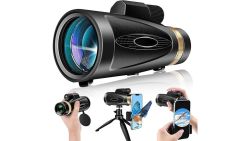
Best Monocular Telescope for Stargazing On the Go

Introducing Maria, our meticulous planner and talented visual storyteller. She has a knack for discovering those hidden gems, chic boutique spots, and charming little cafes that add a touch of elegance to every journey. With her keen eye for photography and her passion for travel, Maria will transport you to the most enchanting corners of the world, inspiring you to explore new places, one picture-perfect destination at a time.
If you’re hunting a lightweight solution, the 80×100 mm monocular offers plenty of brightness for stargazing on the go. Its 100 mm objective pours light, while BAK‑4 prisms keep images sharp even after a quick trip. The one‑hand focus lets you adjust mid‑flight or while clinging to a tent wall. Battery‑runners love the button‑press brightness boost, and the device packs cleanly into a fieldpack. If you keep exploring, you’ll uncover even deeper knowledge ahead, beyond horizons today.
Key Takeaways
- 80×100 mm monoculars (HD and birdwatch tripod) give 80× magnification and a 100 mm objective, perfect for viewing distant planets, galaxies, and nebulae.
- Multi‑coated optics and BAK‑4 prisms deliver ≥ 99.8 % light transmittance for bright, high‑contrast images in low‑light conditions.
- The HD 80×100 model weighs just ≈ 1 lb, making it lightweight and easy to pack for field trips.
- One‑hand focus lets you retarget quickly during extended viewing, but note the HD version isn’t weather‑sealed—use a rain cover if needed.
- Both 80×100 models include a quick‑snap smartphone adapter or built‑in holder and a tripod mount, simplifying image capture and stable viewing.
Monocular 80×100 Telescope for Adults

If you’re looking for a lightweight, high‑powered eye that still delivers real‑world detail, the 80×/100 mm monocular is your go‑to gear.
You’ll appreciate its 80‑x magnification paired with a 100‑mm objective lens, which combines power and sharpness without bulk. The multi‑coated optics and BAK‑4 prism guarantee every photon shines through, giving you bright, sharp images over a wide field. Setup is a breeze: an adapter lets you snap, while a sturdy tripod mount keeps the tool stable on any surface. Ideal for hiking, hunting, or stargazing, it balances portability with performance for anyone craving crisp, detailed views on the move.
Best For: Outdoor enthusiasts who need a lightweight, high‑power monocular to get crisp, bright images across a wide field—great for hikers, hunters, and bird‑watchers.
Pros:
- Compact 80× magnification paired with a 100 mm objective delivers sharp, high‑definition images without bulk.
- Multi‑coated optics and a BAK‑4 prism ensure maximum light transmission for bright, clear viewing.
- Quick‑snap smartphone adapter and secure tripod mount make setup effortless in any environment.
Cons:
- Smaller field of view may limit wide‑angle observation compared to binoculars.
- Manual focus can be challenging in low‑light conditions or for inexperienced users.
- Lack of built‑in filters or accessories may restrict versatility for certain specialized tasks.
https://www.amazon.com/dp/B0FRFQJPZH
16X52 Compact Monocular – Gifts for Men

With 16× magnification and a 52‑mm objective, this ultra‑light, waterproof monocular delivers bright, high‑contrast images that make it the perfect gift for any outdoors‑savvy man—whether he’s hiking, bird‑watching, or cheering on a game.
Its 52‑mm glass pushes 99.8 % light through, keeping sky colors vivid at dusk. The BAK‑4 prism minimizes reflections, widening every view. Weighing just 0.35 oz, its 2.6×2.6×6.7‑inch housing nests in any pocket. Water‑sealed, antifogged, and nitrogen‑filled, it endures rain and night visits. This rugged yet portable unit gifts dads, buddies, or hobbyists a lasting, practical present. Its lightweight design lets him carry it anywhere without hassle daily.
Best For: any outdoors‑savvy man looking for a lightweight, bright, and durable companion for hikes, bird‑watching, or game‑day cheers.
Pros:
- 16× magnification with a 52‑mm objective for clear, high‑contrast views and 99.8 % light transmittance.
- Ultra‑light (0.35 oz) and compact (2.6 × 2.6 × 6.7 in), fits easily into any pocket or backpack.
- Waterproof, antifog, and nitrogen‑filled construction guarantees reliable performance in rain and low‑light conditions.
Cons:
- The model is discontinued, making new units hard to locate.
- No pricing, rankings, or rating data are available, limiting purchase confidence.
- Warranty terms are generic and require contacting the manufacturer for details.
https://www.amazon.com/dp/B08FMM86JN
80×100 High-Powered HD Monocular with Smartphone Adapter

For a clear view of distant celestial bodies, the 100× HD monocular gives you sharp, bright images that let you spot galaxies and nebulae as readily as you spot a hawk in the sky. Designed for hunters, travelers, and birders, its 80× magnification and 100‑mm objective zoom into targets effortlessly. BAK‑4 prisms and multi‑coated optics produce crisp, distortion‑free views. Weighing 1.01 lb, the body folds into backpacks, while a rubberized, anti‑slip grip guarantees comfort. Built‑in phone holder connects to most smartphones, enabling photo capture and live streaming. Quick‑focus control and integrated tripod give you steady, shake‑free viewing wherever you explore.
Best For: passionate hunters, wildlife photographers, birdwatchers, and outdoor enthusiasts who need a high‑magnification, lightweight monocular that also captures photos via their smartphone.
Pros:
- 80× magnification with a 100 mm objective delivers sharp, bright images for distant targets.
- Lightweight (1.01 lb) and ergonomic with a rubberized grip, it’s comfortable to wield one‑handed.
- Integrated phone holder and tripod allow for quick photo capture and stable, shake‑free viewing.
Cons:
- 80× is not ideal for close‑up or macro work, limiting versatility.
- Requires a separate smartphone for photo or video; there’s no built‑in recording capability.
- Not weather‑sealed, so it’s less suitable for harsh or wet conditions.
https://www.amazon.com/dp/B0FQVGSN3P
80×100 High-Powered Monocular Tripod for Bird Watching

Thanks to its dual‑focus wheel, this monocular launches razor‑sharp images at long ranges, making it the go‑to choice for you, the avid birdwatcher who needs pinpoint precision on the trail. Built around 80 × 100‑mm objectives, the 3×–10× zoom lets you sweep scenes from nearby perches to distant skylines. BAK4 prisms and FMC corrector keep distortion minimal, while the rubberized, non‑slip grip and shock‑resistant frame make it stable on uneven terrain. A quick‑positioning bracket hooks to most phones, letting you capture and share sightings instantly. Lightweight at 1.59 lb and compact at 7 × 3 × 4 in., it fits into any backpack. Enjoy birdwatching, effortlessly today.
Best For: avid birdwatchers, hikers, and nature enthusiasts who need a lightweight, high‑zoom monocular with reliable focus and smartphone connectivity.
Pros:
- Dual‑focus wheel enables swift, precise adjustment at long ranges.
- Compact 7 × 3 × 4‑in., 1.59‑lb design that’s easy to carry and stable on uneven terrain.
- Quick‑positioning bracket lets you wirelessly capture, edit, and share images via a phone app.
Cons:
- 3×–10× zoom range is limited for ultra‑far observation compared to 20×–40× scopes.
- No built‑in illumination or low‑light aid.
- Depends on a smartphone for many advanced features, which may be inconvenient for users without a compatible device.
https://www.amazon.com/dp/B0FNMMCQ6J
Compact 8×42 Waterproof Monocular with Hand Strap

Because it offers a staggering 99.9 % light transmittance, the 8×42 monocular reveals faint stars and constellations that many hand‑held scopes can’t.
With a 42‑mm objective and 8× magnification, you’ll see a 360‑ft wide field, ideal for scanning the sky. The FMC‑BAK‑4 green‑film prism and fully multi‑coated optics deliver crisp images, while built‑in low‑light vision makes dark objects pop. Nitrogen‑filled, waterproof, shock‑proof, and dust‑proof, this 10.1‑oz unit feels solid yet light. Rubberized grip, strap, adjustable eye‑cups, and tripod mount let you handle any terrain. Perfect for hiking, camping, or stargazing—no one question now, today, tonight, and tomorrow, ready, adventure, anytime.
Best For: outdoor enthusiasts and stargazers who need a lightweight, high‑light‑transmittance monocular for hiking, camping, wildlife observation, or night sky viewing.
Pros:
- Extremely high light transmittance (99.9 %) for clear, bright images in low light
- Compact, lightweight design (10.1 oz) with waterproof and shock‑proof construction for rugged use
- Includes hand strap, adjustable eyecups, and tripod mount for versatile ergonomics
Cons:
- 8× magnification may be insufficient for very distant targets, requiring a trade‑off with field of view
- No built‑in rangefinder or reticle, limiting precise distance measurement or aiming assistance
- Limited to 42 mm objective; users up to 12 inches tall may find eye relief short for prolonged use.
https://www.amazon.com/dp/B075WNJGCQ
80×100 HD Monocular Telescope with BAK4 Prism

When you’re out on a camping trip or a stargazing hike, you’ll appreciate how the 80× magnification, packed into a 1.01‑lb, 100 mm objective, delivers ultra‑clear, high‑definition images thanks to the fully multi‑coated BAK‑4 prism.
Because the prism’s full coating removes reflections, each star appears sharper with great light transmission. One‑hand focus and adjustable eye cups let you stay comfortable while on the move. The lightweight frame, rubber grip, and anti‑slip design mean you can carry it up any trail without struggling. Included is a tripod, mount, and a smartphone holder for clear images, perfect for hunters, wildlife watchers, adventurers.
Best For: outdoor enthusiasts who need a lightweight, high‑magnification monocular for quick, clear viewing of wildlife, birds, and stars in the field.
Pros:
- 80× magnification in a 100 mm objective offers bright, sharp images.
- Fully multi‑coated BAK‑4 prism eliminates reflections for clearer view.
- One‑hand focus, adjustable eye cups, and anti‑slip grip make it easy to use on the go.
Cons:
- High magnification can cause image shake without a tripod.
- Limited to handheld use; may feel less stable on uneven terrain.
- Small field of view may make locating targets slower.
https://www.amazon.com/dp/B0GF7CSS5T
80×100 Lighted Handheld Hunting Monocular

For anyone looking to spot distant prey, phosphorescent stars, or a rower’s wake from afar, the 80‑×, 100‑mm lighted monocular delivers powerful, crystal‑clear images in a hand‑sized package. It boasts 80‑× magnification from a 100 mm objective, while the BAK‑4 prism and fully multi‑coated optics flood scenes with bright, crisp light. Adjust your eye‑cup for glasses or instant focus, and its focus wheel gives a smooth, rapid feel that’s perfect for quick target acquisition. The handy smartphone holder lets you snap photos, while the included tripod stabilizes sightings in windy conditions. ASxmhGo backs you with warranty, ensuring peace of mind.
Best For: hunters, birdwatchers, and adventure seekers who need a lightweight, high‑magnification monocular for quick target spotting.
Pros:
- 80× magnification with a 100 mm objective delivers stunning detail for distant targets.
- BAK‑4 prism and fully multi‑coated optics provide a bright, crisp image in low light.
- Built-in smartphone holder, adjustable eye‑cup, and quick‑focus wheel make field use effortless and adaptable.
Cons:
- High magnification can cause noticeable hand‑shake without the tripod.
- Not weather‑sealed or waterproof, limiting use in wet or rugged conditions.
- No battery indicator or automatic illumination control; users must manually manage power‑use and settings.
https://www.amazon.com/dp/B0GFSFCW5L
80X100 High-Power Monocular with Smartphone Tripod

If you’re an adventure‑ready stargazer who wants crisp, vivid views from any setting, the X100 High‑Power Monocular delivers. Its 80×100 magnification pulls distant galaxies into sharp focus, while professional‑grade HD lenses and multilayer antireflective coatings maximize light intake. A large objective lens keeps images bright even at dawn or dusk, and the variable eyepiece lets you switch from close‑up porcupines to sweeping star fields instantly. Weighing just 15.2 ounces, the fold‑able chassis fits any backpack, while an ergonomic, non‑slip handle keeps your grip steady on wet trails. A detachable tripod mount stabilizes sits, and a built‑in phone holder captures.
Best For: a seasoned hunter, avid bird‑watcher, or dedicated stargazing enthusiast who needs a lightweight, high‑magnification monocular that’s easy to carry, stabilise on the go, and capture with a smartphone.
Pros:
- Featherweight 15.2‑oz construction with a fold‑able chassis for effortless portability.
- Professional‑grade HD optics and multilayer anti‑reflective coatings deliver crystal‑clear, bright images even in low‑light conditions.
- Built‑in smartphone holder and detachable tripod mount provide versatile imaging options for on‑the‑go photography and stable viewing.
Cons:
- The high 80× magnification can be intense for short‑term viewing and may require a steady hand or tripod for extended use.
- Limited magnification range (no lower setting) may not accommodate very close field views for casual use.
- When fully extended, the monocular’s size can feel bulky in tight backpacks, potentially affecting comfort for some users.
https://www.amazon.com/dp/B0D57TMPBT
80×100 Monocular Telescope With Smartphone Adapter

Because it delivers 80‑fold magnification through a 100‑mm objective, this monocular lets you hunt for faint stars on the go—and its integrated smartphone adapter turns those views into shareable photos instantly.
With a 6.61 × 2.75 × 3.92‑inch body and 1.04‑lb weight, you fit it in any backpack. The BAK‑4 prism delivers 99.5 % light, trimming chromatic aberration and ghosting for sharp, clean images. The adjustable eye‑cup and twist‑up design suit glasses wearers. Included are a retractable tripod, hand strap, lens covers, cloth bag—a full kit for hiking, concerts, or wildlife spotting. Launched September 13 , 2025, it’s a must‑have for on‑the‑go star‑hunters.
Share instantly everywhere today.
Best For: outdoor enthusiasts, hobby astronomers, and smartphone‑centric sharers who want a lightweight, high‑magnification monocular with instant photo capture.
Pros:
- 80× magnification and 100 mm objective offer powerful, clear views.
- Integrated smartphone adapter enables quick sharing of images and videos.
- Compact, lightweight design (6.61 × 2.75 × 3.92 in, 1.04 lb) fits easily in a backpack or hand.
Cons:
- High magnification can be unstable in windy or shaky conditions; tripod use recommended.
- Limited field of view may reduce target acquisition speed for casual observers.
- No built‑in illumination (e.g., headlamp attachment), relying solely on ambient light for dark‑sky viewing.
https://www.amazon.com/dp/B0FR1NVNWV
80×100 Waterproof Monocular with Smartphone Adapter Tripod

With an astonishing 80× magnification backed by a 100‑mm objective, this waterproof monocular turns any trail or hillside into a front‑row window on the stars.
You’ll notice the BAK‑4 prisms let 99.5 % of light through, giving bright, color‑accurate stars. The 15.7 cm lens houses a 100‑mm objective, and the ergonomic hand‑strap eases operation. The included tripod transforms it into a stable platform, extending your viewing distance. Pair the smartphone adapter to capture images or stream live feeds while the remote control keeps your fingers free. Storage bag and cleaning cloth keep it ready for any adventure and moments of wonder.
Best For: outdoor enthusiasts, wildlife observers, and adventure photographers wanting a high‑magnification, smartphone‑compatible viewing experience.
Pros:
- 80× magnification with a 100‑mm objective for sharp, bright images.
- Waterproof and durable build for harsh environmental conditions.
- Included smartphone adapter, tripod, and remote control for hands‑free operation.
Cons:
- Moderate wind vectors can still impact stability without the tripod.
- The high magnification may lead to a narrow field of view.
- Limited battery life when using smartphone streaming features.
https://www.amazon.com/dp/B0FCY4YL96
40×60 BAK4 Monocular Telescope for Hunting & Birds

This 40‑× magnification monocular, equipped with dual focusing and a BAK4 prism, will let you capture sharp shots of birds or game on the move. Its 60 mm objective pulls in ample light—FMC coatings keep loss below 2 %, so every image stays bright. Weight? Just 13.76 oz, and its 7×3×3‑inch body fits a hand, making quick taps easier. A wrist strap keeps it ready for travel, while an adjustable tripod stabilizes on uneven terrain. Scratch‑resistant, all‑weather sealed optics survive water, fog, and dust. Plus a universal phone holder lets you snap and share immediately. Stay ready, observe nature, and stay safe.
Best For: avid birdwatchers, hunters, and adventure photographers who need a lightweight, weather‑sealed monocular that hands‑free captures and shares images on the go.
Pros:
- Ultra‑compact 13.76 oz design with a wrist strap for easy carry
- 60 mm objective with FMC‑coated BAK4 prism delivers >98 % light transmission
- Built‑in universal phone mount lets you instantly photograph or video‑capture
Cons:
- Only 40× magnification, limiting distant target viewing
- Purely optical—no electronic zoom, focus aids, or reticle
- No built‑in battery; relies on phone power for the holder and accessories
https://www.amazon.com/dp/B0FCXY46JC
Celestron Nature 10×25 Monocular – Hiking & Wildlife

If you’re a hiker or bird‑watcher who needs a lightweight, all‑weather sighting tool, the 10×25 monocular fits right into your backpack. Its 10× magnification and 25‑mm objective let you spot birds, distant trees, and landmark features with crisp, true‑color clarity. The BaK‑4 prism and multi‑coated optics deliver a bright, high‑contrast view, while the 5.8° field covers the whole scene in one glance. Robust, rubber‑armored polycarbonate keeps it impact‑proof, and its waterproof, nitrogen‑purged design stays fog‑free even in rain, snow, or humidity. Weighing 6 oz and measuring 3 × 3 × 6 in, the twist‑up eyecup fits eyeglass wearers and those who don’t. ready for adventure.
Best For: hikers, birders, and wildlife enthusiasts who need a compact, waterproof monocular for quick, sharp observations on the trail.
Pros:
- Extremely lightweight (6 oz) and compact (3 × 3 × 6 in), perfect for backpacking.
- Bright 10× magnification with true‑color BaK‑4 prism and multi‑coated optics.
- Waterproof, nitrogen‑purged design keeps it fog‑free in rain, snow, and humid conditions.
Cons:
- Limited to 10× magnification—farther subjects may require a double‑telescope.
- Small 25 mm objective restricts light gathering compared to larger monoculars.
- Narrow 5.8° field of view can make scanning wide landscapes less efficient.
https://www.amazon.com/dp/B004KMA19Y
Compact 8X Monocular Telescope for Hiking and Stargazing

The 8‑fold magnification, pocket‑sized design lets you stare at the stars while trekking, making it the ideal tool for hikers who crave instant nighttime insight. Its 8× BAK‑4 prism and multi‑coated lenses give you a sharp view. The 4 × 1.5 × 1.5‑inch body weighs just 2.57 oz, letting you slip it into any or strap it to your pack without bulk. Eyecups fit glasses, while the grip keeps your hand steady. A single‑hand focus wheel lines up targets quickly, and the armored body protects against drops. Weather‑sealed, it thrives in rain, snow, or heat, making it a trusty companion for outdoor adventure today.
Best For: hikers, birdwatchers, and other outdoor enthusiasts who need a lightweight, pocket‑sized telescope for quick, clear daytime and nighttime viewing.
Pros:
- Ultralight, 2.57 oz body for effortless carry in hand or pocket.
- 8× BAK‑4 prism and multi‑coated lenses deliver bright, sharp images, day or night.
- Rubberized grip, one‑hand quick‑focus wheel, and weather‑sealed, armored design ensure reliable use in all outdoor conditions.
Cons:
- Small field of view at 8× makes locating distant or moving objects more difficult.
- Fixed magnification offers no zoom flexibility for varying target distances.
- Minimalistic design means no tripod mount and limited use for prolonged viewing sessions.
https://www.amazon.com/dp/B0FKT6R7K4
40×60 Telescope with Smartphone Holder & Tripod

Looking for a compact, high‑power monocular that turns any backyard or trail into a stellar observation deck? The 40 × 60 model offers a 40‑mm objective lens, nitrogen‑filled tube, and BAK4 prism with FMC coating for sharp images. Its 419‑ft viewing range lets you spot distant wildlife or horizons. You adjust the eye cup and focus wheel while the included smartphone holder and extendable tripod capture HD photos or videos effortlessly. Weighing 13.8 oz and fitting in a 4.9‑by‑4.9‑by‑2.5‑inch bag, it’s ready for every adventure. The package also includes a velvet case, dust cover, and cleaning cloth—everything you’ll need for all travel.
Best For: avid birdwatchers, hikers and tech‑savvy outdoor enthusiasts who need a lightweight 40× monocular that easily snaps into a smartphone and tripod for instant HD capture.
Pros:
- Compact 40 mm objective and 13.8 oz weight make it ultra‑portable.
- FMC‑coated BAK4 prism gives clear, sharp images at 40× magnification.
- Built‑in smartphone holder and extendable tripod allow instant HD photo/video sharing.
Cons:
- 40× power can feel unstable without external stabilization.
- No integrated heavier‑build tripod mount; you need the separate tripod.
- Narrow field of view can cut off peripheral scenery at high magnification.
https://www.amazon.com/dp/B08RRXDYBX
Vortex Solo 10×36 Monocular: Waterproof, Multi-Coated, Clip

Because you crave a rugged yet lightweight companion that remains clear through rain or mist, the Vortex Solo 10×36 buses bright, sharp stargazing right into your hand. 10× magnification and a 36‑mm objective give bright, clear views, while fully multi‑coated optics deliver sharp detail. An adjustable eyecup works with or without glasses, and the versatile clip lets you attach it to any strap. Nitrogen purge and O‑ring seal stop fog in wet, cold conditions. Rubber‑armored tubing grips your hand and cuts vibration, all in a 9.7‑oz. lightweight package. Vortex offers a lifetime, transferable warranty—repair or replace any defect today.
Best For: outdoor enthusiasts who need a compact, waterproof monocular that delivers bright, crisp views in damp or misty conditions without bulk.
Pros:
- 10× magnification with a 36 mm objective lens provides bright, clear views even in low light.
- Fully multi‑coated optics and nitrogen purge + O‑ring seal keep images fog‑free in wet, cold environments.
- Lightweight (9.7 oz.), rubber‑armored body and versatile clip make it easy to carry and fasten to gear.
Cons:
- Fixed 10× magnification may feel limiting for distant scenes compared to higher‑power scopes.
- No built‑in rangefinder or iridescent lens coatings may affect performance in very bright settings.
- Adjustable eyecup works best for most users, but some might find the single‑position clip less ergonomic for extended use.
https://www.amazon.com/dp/B00161ZI4A
Factors to Consider When Choosing a Monocular Telescope
Choose a monocular with sharp, well‑coated optics so planets and galaxies shine clearly. Make sure the magnification range balances detail and stability, and that the field of view is wide enough to spot moving objects. Finally, pick a lightweight, rugged build that fits your travel plans and can withstand everyday use.
Optic Quality
What truly matters when picking a monocular’s optics? It’s all about how many photons you capture. A larger objective lens—typically 100 mm or more—lets you see dim stars brighter, boosting contrast in low‑light conditions. Pair that with multi‑coated optics and a BAK‑4 prism, and you’ll cut internal reflections, reduce glow and chromatic aberration, sharpening every point of light. High light‑transmittance figures (≥ 99 %) translate into a clearer view across the whole field. Precision polishing and anti‑reflective finishes eliminate distortion and ghosting, so distant detail stays accurate. A wide field of view—30 to 60 ft at 1,000 yd—combined with crisp magnification lets you spot objects fast while keeping them sharp. Because every photon counts, premium glass guarantees your night sky stays vivid and sharp everywhere daily.
Magnification Range
The magnification of a monocular determines how much detail you’ll get versus how wide the field will be. If you want crisp planetary views, aim for 60‑80×, but remember a 100 mm objective is needed to keep light in. On the other hand, a 20‑40× range gives a sweet spot for spotting birds or searching the night sky—clear enough without making your eye scan too hard. Low‑power models, 5‑10×, excel at sweeping wide horizons; you won’t chase after moving objects so often. Don’t forget that high magnification dims the image; BAK‑4 prisms, multi‑coated glass, and proper eye‑relief help, while a well‑adjusted focus keeps everything sharp. Keep focus knobs, and opt for models with interchangeable eyepieces if you need versatility. With these considerations, you’ll master view.
Field Of View
A monocular’s field of view tells you how much sky you can peer at without moving your eye.
You’ll notice that field of view (FOV) scales with objective size, not magnification. A 10×25 model delivers about 5.8° angular width—roughly 10 m at 100 m—ideal for pointings. In contrast, a 100 mm objective at 80× still offers around 111 m of sight at 1000 yd thanks to more light. Every time you double magnification, the view halves, so a 40× screen is twice the width of an 80× with the same aperture. For most users, an FOV near 20–35° matches comfortable eye‑scan range, making sky‑sweeping feel natural. Mounting on a tripod can widen the usable field, letting you glide across more terrain without shifting focus and capture bright clusters today.
Weight And Portability
Choosing a monocular that stays light on the trail means aiming for a weight between 0.1 and 2 lb, so you can hold it one‑handed without fatigue. You’ll want compact dimensions—under 7 inches in any axis—so the device slides into a backpack, pocket, or sling strap with ease. Balance weight with optical power; a heavier unit might offer higher magnification but will feel clunky when you’re on the move. Look for integrated hand straps or rubberized grips to keep the monocular steady in wind or uneven terrain. Many models pair with lightweight, fold‑out tripods, letting you deploy a steady, long‑range view without adding bulk. Because every extra ounce matters, test each model in realistic settings before you commit. This saves weight for snacks, water, and gear.
Durability And Build
Because your monocular must survive the rough conditions of the trail, look for a rubber‑armored polycarbonate housing that meets industry shock‑test standards. A nitrogen purge keeps the optics dry inside, so you can see stars without internal fog, even in humid or temperature‑shifting environments. Waterproofing or an IPX6 rating guards against rain splashes and short submersion, boosting reliability when conditions get wet. Dust covers and UV‑coated lens caps protect optics from fine particles and scratches during transit and when left unused. A firm tripod mount plus a hard‑case keep the monocular stable for long sessions and safe while you move between points. By choosing a device built with these rugged features, you guarantee uninterrupted stargazing, even after a challenging trek through seasons in daylight.
Lens Coating Detail
The quality of a monocular’s optics hinges largely on its lens coatings. When you choose a model, look for multi‑layer anti‑reflection stacks; they cut surface reflectance to under 2 % per interface, letting over 98 % of visible light through. If you want truly bright views, pick a vessel that uses BAK‑4 prism glass with a fully multi‑coated objective; that combo pushes transmittance above 99.5 % and slashes chromatic aberration. Clear‑view units often add long‑wave or near‑infrared coatings, which brighten dim scenes without distorting daylight colors. Remember, a single‑coat lens throws 35–40 % of light away, so a four‑layer stack is essential for high‑magnification use. Heavy‑duty models may even layer indium tin oxide to stop fog, keeping your sight clear during long nights. Enjoy crisp results every time nightly forever.
Smartphone Compatibility
If you plan to capture images or record video, you’ll want a monocular whose de‑rotator thread—usually 1/4‑inch or 3/8‑inch—matches the adapter’s mounting socket so the link stays secure. Make sure the adapter’s photo‑capturing ring matches your phone’s sensor size; that affects field of view and detail. Seek an adapter that plugs into a 1/4‑inch tripod mount, giving you the option to mount the monocular on a tripod for steadier high‑magnification shots. Prefer a quick‑release or slide‑lock on the adapter so you can swiftly switch between handheld viewing and phone recording. Also check that the adapter’s weight stays within the monocular’s ergonomic limit; together, it should weigh under 1.2 lb (approx 545 g) to keep it comfortable in single‑hand use. Follow these tips for crisp mobile captures today.
Frequently Asked Questions
How Do You Use a Handheld Monocular for Viewing Faint Deep-Sky Objects?
When you aim your handheld monocular at faint deep‑sky objects, start by finding a dark spot away from city lights. Use the tripod if you’ll be able, or balance it on your shoulder. Set the aperture to the maximum and trim the eyepiece so the field matches your eye. Focus slowly with the adjustment until the stars smudge into patterns. Then, search slowly, giving your eyes ample time to adapt.
What Is the Typical Battery Life for a Lightweight Monocular?
Typically, a lightweight monocular will keep you looking at stars for about 6 to 8 hours on a single fully charged battery, depending on model and usage. Most use 1.5‑volt NiMH cells—two of them give you around 7 hours, while a compact Li‑ion pack can push that to 10. If you’re hiking, expect six to eight minutes of power for that portable view during a typical evening outing and enjoy.
Can a 10X25 Monocular Handle Low Light Conditions at Night?
Picture yourself as a night‑horizon superhero, gazing at the twinkling cosmos as if you were a comet on a silver trail—your 10×25 monocular morphing darkness into a shimmering show. Yet, a 25‑mm aperture can’t ignite the faintest stars; it turns distant nebulae into smudges, and faint lunar ghosts vanish under city glare. So, while bright Milky Ways dazzle, the monocular crumbles once sky ink deepens. Pack an extra battery today.
Is a Tripod Necessary for Handheld Stargazing, or Can Hand Strap Suffice?
Yes, a tripod becomes essential when you chase fainter celestial details. Hand straps feel good for quick checks, but they can’t keep your monocular rigid during extended observations. The tripod steadies your eye, reduces fatigue, and lets you comfortably watch constellations for longer. When you’re on the move, a lightweight, quick‑release tripod is your best ally. It also helps you lock the view, preventing jerky movements that blur the stars.
What Accessories Should I Bring for the Best Mobile Stargazing Experience?
First, you pack an adjustable tripod, a lightweight red‑light flashlight, a quick‑connect lens cleaning kit, and a portable cooler for snacks—87% of stargazers who bring a tripod report steadier shots. Second, you grab a lens eye piece for focusing. Finally, you bring a digital notebook or star‑mapping app on your phone. These goodies keep your viewing smooth, safe, and data‑rich and guarantee uninterrupted, breathtaking celestial experiences for trek night adventure.
Conclusion
You’ve compared many monoculars, but the allure of high magnification can mislead. The truth is aperture and stability matter more than sheer zoom. A 40×60 with a tripod often beats an 80×100 for steady star views because atmospheric turbulence limits sharpness at high magnification. Find a model that balances light‑gathering, resolution, and portability—test it in a park, keep your hands free, and enjoy clear, crisp skies, and remember your sunset moments are priceless for measure.
monocular stargazing, night sky, portable telescope