Top Monocular Telescopes That Deliver Stunning Night Skies

Introducing Maria, our meticulous planner and talented visual storyteller. She has a knack for discovering those hidden gems, chic boutique spots, and charming little cafes that add a touch of elegance to every journey. With her keen eye for photography and her passion for travel, Maria will transport you to the most enchanting corners of the world, inspiring you to explore new places, one picture-perfect destination at a time.
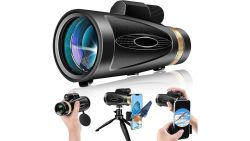
Looking for crisp night skies? You’ll love the 80×100 HD Monocular with tripod and phone adapter—80× power, full‑coated lenses, and smartphone integration make star‑gazing effortless. The 80×100 Green Monocular adds adjustable zoom and a BAK‑4 prism for vibrant detail. A lightweight 16×52 option balances portability and clarity, while the rugged 8×42 delivers 360‑ft view under harsh weather. Want to see why these stand out that will wow your senses today? Keep exploring for more insight.
Key Takeaways
- Opt for an 80× magnification with a 100‑mm objective; its large aperture and multi‑coated optics deliver bright, crisp star views.
- BAK‑4 prisms keep >99 % of light passing, essential for deep‑sky imaging and nebula detail.
- Dual‑focus wheels allow quick centering on distant stars or planets, minimizing search time in the dark.
- Built‑in tripod mounts—or add a lightweight tripod—enable long exposures without hand‑shake distortion.
- Waterproof, fog‑proof housings retain image quality in humid or rainy night‑time conditions, ensuring reliability outdoors.
80×100 HD Monocular with Tripod & Phone Adapter

If you’re a birdwatcher, stargazer, or hiking enthusiast who values a crisp, bright image in a single hand, this 80‑x 100 mm HD monocular is your go‑to tool—especially with its built‑in tripod and quick‑position phone adapter for instant sharing. Your eye cup adjusts automatically, letting you see cleanly without glasses. The 100 mm objective delivers a wide, bright view, while the BAK‑4 prism and multi‑coating slash refraction loss. One‑handed operation locks targets fast—ideal for bird calls or distant starlights. Its compact 6.61‑in diameter, weight just 1.46 lb, makes it portable for hikes, camps, or travel. The quick‑position adapter fits most smartphones, letting you snap moments straight to social media. A perfect gift for Father’s Day, birthdays, or Christmas, it blends performance, versatility and convenience into one sleek package.
Best For: Outdoor enthusiasts who need a lightweight, high‑magnification viewing tool with instant smartphone sharing—ideal for birdwatching, stargazing, hiking, and travel.
Pros:
- Bright, sharp HD image from 100 mm objective and multi‑coated Glass/Bak‑4 prism.
- Portable 1.46 lb and 6.61‑in diameter—fits easily in one hand and on a backpack.
- Includes tripod and quick‑position phone adapter for stable, shareable shots.
Cons:
- 80× magnification can be too intense for extended viewing or very small targets.
- Field of view may feel narrow compared to lower‑magnification binoculars.
- Limited to the built‑in phone adapter; other recording devices need separate mounting.
https://www.amazon.com/dp/B0FRFQJPZH
80×100 High-Powered Green Monocular, Tripod & Smartphone Compatible

You’ll hardly miss a feathered friend when you bring the 80 × 100 high‑powered green monocular into the field—a must‑have for bird‑watchers and hunters who crave crisp, long‑range images.
With an adjustable 80‑×‑100× zoom and BAK4 prism, it delivers sharp, vivid scenes. The dual‑focus wheel lets you lock distant subjects quickly, while the FMC lens keeps clarity across the field. A sturdy tripod keeps you steady, and the snap‑on smartphone bracket works with most phones for control and sharing. Durable rubber grip and scratch‑resistant housing make it ready for rugged trips. Weighing just 1.59 lb, the KTBDING model fits comfortably in hand.
Best For: Bird‑watchers, hunters, and nature enthusiasts who need crisp long‑range views and smartphone compatibility.
Pros:
- Adjustable 80‑×‑100× zoom with BAK4 prism delivers sharp, vivid scenes at distance.
- Dual‑focus wheel allows rapid, precise focusing on distant subjects.
- Built‑in tripod and smartphone bracket enable steady viewing and easy image sharing.
Cons:
- Heavy for prolonged handheld use due to built‑in tripod.
- Requires a smartphone for remote control, limiting standalone usage.
- Limited versatility for users desiring lower magnification or 3‑way focus.
https://www.amazon.com/dp/B0FNMMCQ6J
16×52 Monocular Gift for Men

This 16‑x, 52‑mm monocular delivers bright, high‑contrast images even in low light, making it the go‑to gift for men who crave crisp views while hiking, bird‑watching, or scouting wildlife. You’ll appreciate the 52 mm objective and BAK‑4 prism that let 99.8 % of light through, so images stay vivid without black bars. Its ultra‑light 0.35 oz body measures just 2.6 × 2.6 × 6.7 in, making it easy to carry on any adventure. Fully nitrogen‑filled, waterproof and fog‑proof, it survives rain, humidity, and the night’s chill. Ideal for birthdays, holidays, or Valentine’s presents, this Pankoo model still shines as a rugged, reliable companion—nobody will outshine it ever.
Best For: men who love outdoor adventures and need a lightweight, bright monocular for hiking, bird‑watching, or wildlife scouting.
Pros:
- 99.8 % light transmission gives vivid, high‑contrast images even in low light.
- Ultra‑light 0.35 oz and compact 2.6 × 2.6 × 6.7 in body for easy portability.
- Fully nitrogen‑filled, waterproof, fog‑proof, and rugged for rain and humid conditions.
Cons:
- 16× magnification may be too low for very distant viewing.
- The model is discontinued, potentially limiting future support.
- No brand‑provided replacement lenses or accessories.
https://www.amazon.com/dp/B08FMM86JN
80×100 HD Monocular with BAK4 Prism & Adapter

For anyone who values crisp, clear views without bulky gear, the 80× 100 mm HD monocular with a BAK‑4 prism is the perfect choice. Its 80× magnification and 100‑mm objective deliver bright, sharp images, while the fully multi‑coated lenses cut distortion and boost light transmission. Handheld and lightweight at just 1.01 lb, you can carry it on hikes or camping trips without fatigue. The rubberized grip resists slipping, and the adjustable eye cups make it comfortable for glazier and non‑glazier users alike. A handy tripod and integrated smartphone holder let you stabilize shots and share sightings instantly for spectacular night sky.
Best For: Outdoor enthusiasts who need a lightweight, high‑definition monocular for quick wildlife spotting, bird watching, or trekking without carrying bulk equipment.
Pros:
- 80× magnification with 100 mm objective for bright, sharp images
- Fully multi‑coated lenses and BAK‑4 prism reduce distortion and enhance light transmission
- Lightweight (1.01 lb), ergonomic design with rubberized grip and adjustable eye cups
Cons:
- Limited field of view compared to lower‑magnification binoculars
- No built‑in rangefinder or advanced weatherproofing
- Requires separate tripod for optimal stability in low‑light conditions
https://www.amazon.com/dp/B0GF7CSS5T
80×100 High-Def Monocular with Smartphone Adapter

When you’re out on a trail chasing wildlife or hunting, the 80× 100 mm monocular’s lightweight, handheld body makes it easier to carry than a traditional scope, and its built‑in smartphone holder lets you capture crisp, high‑definition photos without a separate camera. Its 80× magnification delivers a 100 mm aperture, giving you a bright, expansive view with minimal distortion thanks to the fully multi‑coated BAK‑4 prism. You can adjust the eye cups for comfort, whether you’re wearing glasses or not. The compact 6.61‑by‑2.75‑by‑3.92‑inch frame weighs just 1.01 lb, so it fits comfortably in your pocket or glove. Its tripod guarantees steady shots.
Best For: outdoor enthusiasts, hunters, and wildlife observers who need a lightweight, mobile optical device with built‑in smartphone capture capability.
Pros:
- 80× magnification with a 100 mm objective delivers a bright, expansive view with minimal distortion.
- Fully multi‑coated BAK‑4 prism and lens array provide superior light transmission and ultra‑clear image quality.
- Lightweight (1.01 lb) handheld design, adjustable eye cups, and a built‑in smartphone holder make it easy to use on the move.
Cons:
- 80× magnification may be insufficient for very distant or large‑scale observations (e.g., bird migration).
- The device relies on a compatible smartphone for photography, limiting use with older or non‑standard phones.
- No built‑in battery or power source; photography depends on the phone’s battery life.
https://www.amazon.com/dp/B0FQVGSN3P
8×42 Waterproof Shockproof Hand-strap Monocular

Surrounded by the wilderness, you need a sight that stays reliable in any conditions. This 8×42 monocular delivers sharp 8× magnification through a 42 mm objective, offering a 360‑ft (≈100 m) field of view and 99.9 % light transmittance. The FMC BAK‑4 prism and multi‑coated glass guarantee crisp images, while the nitrogen‑filled, waterproof, fog‑proof, dust‑proof, and shock‑proof housing keeps optics dry on muddy trails. A lightweight 10.1‑oz design lets you hold it single‑handed, and adjustable eye cups let you focus faster. Comes with a hand strap, carry case, and tripod rocker for stability. Use it for hunting, it stays sharp in light.
Best For: outdoor adventurers and wildlife enthusiasts who need a compact, single‑handed, fully waterproof and shock‑proof 8×42 monocular for hiking, hunting, climbing, and bird‑watching.
Pros:
- Lightweight 10.1 oz design with adjustable eye cups for quick focusing.
- Durable, 100 % nitrogen‑filled, water‑proof, fog‑proof, dust‑proof, and shock‑proof housing keeps optics dry in all conditions.
- High‑performance optics: 8× magnification, 42 mm objective, 360‑ft (≈100 m) field of view, 99.9 % light transmittance, and a BAK‑4 prism for crisp images.
Cons:
- Limited to a fixed 8× magnification—no variable zoom.
- Lacks electronic features such as depth gauges or integrated GPS/compass.
- Bulky compared to pocket‑sized monoculars, may not fit comfortably in tight pockets.
https://www.amazon.com/dp/B075WNJGCQ
High-Powered Hunting Monocular with Light, Smartphone Holder, Tripod

Looking for a powerhouse that won’t weigh you down at nightfall on a solo hunt? This 80× monocular, 100 mm optics, BAK‑4 prism, and multi‑coated lenses deliver crystal‑clear, bright images even in low light. Its adjustable eyecup fits glasses, while a quick‑damped focus wheel lets you zero in fast. A built‑in smartphone holder snaps to any device, and the tripod socket keeps you steady during long‑range shots or star‑gazing. Compact at 5.45 × 4.69 × 4.86 in., it tips at only 1.19 lb, making it ideal for hunting, wildlife, mountaineering, or even water sports. Your gear stays surprisingly portable, and battery life lasts through extended adventures.
Best For: rugged outdoor enthusiasts who need a lightweight, high‑magnification optic for hunting, stargazing, or wildlife observation.
Pros:
- 80× magnification and BAK‑4 prism deliver crisp, bright images even in low light.
- Weight only 1.19 lb and compact size makes it easy to carry single‑handed for extended periods.
- Included quick‑align smartphone holder and tripod socket expand the range of activities—from shooting to photography to star‑watching.
Cons:
- The 80× magnification can make tracking fast movements difficult and reduces the field of view.
- Lack of built‑in battery or eye cushion restricts long‑term use and comfort for some users.
- Price point may be high compared to lower‑magnification monoculars that suit casual use.
https://www.amazon.com/dp/B0GFSFCW5L
40×60 Monocular Telescope with BAK4 Prism

If you’re a seasoned birdwatcher or an avid hiker craving a pocket‑sized viewfinder, this 40×/60 mm monocular—thanks to its BAK4 prism—delivers bright, very high‑contrast images without adding bulk. Measuring just 7×3×3 in., it weighs a light 1.23 lb, letting you carry it anywhere. Dual focusing—objective and eyepiece—lets you snap views in seconds, while the advanced FMC coatings keep brightness alive even in dim twilight. It’s weather‑ready: water‑, fog‑, dust‑, rain‑, snow‑, and humidity‑proof, so nothing stops you from watching the wild. The wrist strap and storage bag ease transport; the tripod stabilizes and the phone holder lets you share instantly.
Best For: outdoor enthusiasts such as birdwatchers, hikers, hunters, and anyone who values bright, portable, weather‑proof viewing in a compact format.
Pros:
- 40× magnification and 60 mm objective lens deliver bright, high‑contrast images.
- Dual focusing (objective + eyepiece) allows rapid, precise sharpening even in twilight.
- Weather‑proof construction, wrist strap, tripod, and phone holder make it an all‑weather, on‑the‑go companion.
Cons:
- The single‑eye design limits use for those who prefer binoculars or dual‑eye viewing.
- Narrow field of view can make locating and tracking fast‑moving targets more difficult.
- Without a dedicated sunshades or adjustable eyepiece, prolonged use in strong glare or extreme brightness may become uncomfortable.
https://www.amazon.com/dp/B0FCXY46JC
80×100 High-Power Monocular Telescope with Adapter

When you’re out on a trail, you’ll want a compact tool that can make distant peaks appear close enough to touch—our 80‑fold, 100‑mm monocular does just that in a single, one‑hand‑sized package weighing only 1 lb. Each time you point it toward distant summits, the 80‑fold BAK‑4 prism delivers clear images with chromatic aberration. The 100‑mm objective pours light, while the focus wheel and twist‑up eyecup accommodate glasses. You can strap it to your hand, or mount the detachable tripod and attach your phone with the included bracket. Whether you’re climbing, hunting, or cheering at a game, it fits adventure.
Best For: outdoor lovers—hikers, climbers, hunters, and wildlife observers—who need a lightweight, high‑zoom monocular that fits in a hand and can be set up on a tripod or mounted to a smartphone for instant sharing.
Pros:
- 80× BAK‑4 prism gives sharp, high‑definition images with minimal chromatic aberration.
- One‑hand‑sized, 1 lb design keeps the device portable and easy to carry for extended periods.
- Comes with a retractable tripod, phone bracket, and adjustable eyecup, so it works for both solo viewing and shared photos or videos.
Cons:
- At 100 mm objective diameter, performance in low‑light or twilight environments is limited without external illumination.
- The high magnification can accentuate hand shake; stable viewing requires the included tripod or a firm grip.
- As a monocular, it lacks the natural binocular advantage of twin lenses, making some users feel a bit less comfortable for prolonged observations.
https://www.amazon.com/dp/B0FR1NVNWV
Bushnell Legend 10×42 Ultra HD Monocular

Because it packs a 10× 42 mm lens into a 374‑gram body, the Bushnell Legend 10×42 Ultra HD Monocular is the perfect companion for backpackers and hunters who need quick, crisp views without carrying heavy gear. Its ED Prime glass, paired with Ultra‑Wide‑Band coatings, delivers razor‑sharp, color‑accurate images even in low light. The fast‑focus knob lets you lock onto targets in milliseconds, while the twist‑up eye cup adjusts for glasses or an unaided eye. Lightweight, rubber‑armored, and O‑ring sealed, it resists moisture and condensation—perfect for hiking, hunting, or stargazing. Packed in a rugged black shell, it’s ready in the box.
Best For: hikers, hunters, and outdoor enthusiasts who need a lightweight, high‑magnification optic that delivers sharp, color‑accurate images in low light.
Pros:
- Compact 10× 42 mm lens with ED Prime glass and Ultra‑Wide‑Band coatings for razor‑sharp, color‑accurate views even in low light.
- Fast‑focus knob and adjustable eye cup for rapid target acquisition and comfort with or without glasses.
- Durable rubber‑armored body with O‑ring sealing for waterproof and fog‑proof performance.
Cons:
- 10× magnification may be too strong for casual viewing or wide‑area scanning.
- No built‑in illumination or night‑vision, limiting usability in complete darkness.
- Slightly heavier (374 g) than some single‑lens optics, which can reduce pack lightness for ultra‑light backpackers.
https://www.amazon.com/dp/B006U3ZIVC
80X100 High-Definition Monocular with Tripod, Holder

The 80X100 high‑definition monocular from OEXLUFORD delivers crystal‑clear views for the serious outdoor enthusiast.
You’ll appreciate its 80×100‑mil objective, gathering ample light for clear images even at dawn or dusk. Professional‑grade lenses with multi‑layer coating cut reflections, boosting light transmission. A variable eyepiece gives you multiple magnifications, letting you switch from intimate close‑ups to sweeping panoramas. Fold‑able and lightweight, the compact design slides into backpacks, while the ergonomic handle follows your natural hand curve for a secure grip, even in wet or sweaty conditions. An optional detachable tripod mount stabilizes prolonged observation, and the included smartphone holder lets you capture or share images on the fly.
Best For: Serious outdoor enthusiasts who need a lightweight, high‑definition monocular for hiking, bird watching, hunting, or stargazing.
Pros:
- Professional‑grade optics with multi‑layer coating give bright, clear images even in low light.
- Lightweight, foldable design and ergonomic handle make it highly portable and comfortable for long use.
- Built‑in smartphone holder and optional tripod mount provide versatile photography and stable viewing options.
Cons:
- Variable magnification range is limited compared to high‑end binoculars.
- No built‑in zoom control; adjusting magnification requires manual eyepiece change.
- Detachable tripod mount may not fit all tripod models without an adapter.
https://www.amazon.com/dp/B0D57TMPBT
80×100 Waterproof Monocular with Smartphone Adapter

If you’re looking for a compact yet powerful way to capture the world from a steep cliff or a bustling cityscape, this 80‑fold, 100‑mm monocular offers the perfect blend of portability and performance.
At 100‑mm objective and 80 × magnification, it magnifies sky and street gracefully. Its BAK‑4 prisms and 99.5 % light transmission give crisp, bright images, while full‑coating eliminates streaks and chromatic aberration. The waterproof body withstands rain, dust, and splashes, so you’re ready for any terrain.
Mount your phone with the mount; pair via Bluetooth, shoot, edit, share photos. Tripod clip and hand strap add stability and convenience.
Best For: outdoor enthusiasts, photographers, and adventure travelers seeking a portable yet powerful 80× magnification monocular with smartphone integration for capturing expansive landscapes and detailed cityscapes.
Pros:
- Compact, lightweight design with a 100 mm objective for vivid, high‑magnification viewing.
- Fully coated BAK‑4 prisms and 99.5 % light transmission deliver bright, crisp images while eliminating chromatic aberration.
- Waterproof body, phone mount, and Bluetooth pairing enable versatile, on‑the‑go shooting in any weather.
Cons:
- Limited field of view due to high 80× magnification, best used for distant targets rather than wide scenes.
- Requires a tripod or hand strap at high magnification for sharp image capture and comfortable viewing.
- Heavy focus as 14.4 oz, which can strain the wrist during extended handheld use.
https://www.amazon.com/dp/B0FCY4YL96
Celestron Nature 10×25 Monocular Waterproof Hiking Wildlife

For avid hikers who need a quick, discreet way to spot wildlife from afar, the Celestron Nature 10×25 monocular offers a combo of size, brightness, and ruggedness. With 10× magnification and a 25 mm objective, you get sharp, high‑contrast views of distant birds and mammals. BaK‑4 prisms and multi‑coated optics boost color fidelity, while a 5.8° field keeps whole scenes in frame. Weighing 6 oz in a 3 × 3 × 6‑inch housing, it’s lightweight and easy to carry. Rubber‑armored polycarbonate plus waterproof, nitrogen purged construction protects against drops, rain, and fog. The twist‑up eyecup adjusts for glasses, and Celestron’s lifetime US warranty backs adventure.
Best For: the outdoor enthusiast who needs a lightweight, weather‑proof monocular for quick wildlife spotting on hikes or bird‑watching trips.
Pros:
- Bright 25 mm objective delivers sharp, high‑contrast views at 10× magnification.
- Compact 3×3×6‑inch, 6‑oz design makes it easy to carry and conceal.
- Waterproof, nitrogen‑purged housing keeps the optics fog‑free in rain, snow, and humidity.
Cons:
- 10× magnification can be too low for distant, high‑altitude observation.
- Small objective limits light gathering in low‑light conditions.
- 5.8° field of view is narrower than some binoculars, restricting wide‑angle coverage.
https://www.amazon.com/dp/B004KMA19Y
40X60 High-Power Monocular with Smartphone Holder & Tripod

Birdwatchers on the go will thrive with the X60’s 40‑mm objective lens, pushing a 419‑ft/1000‑yd reach that brings distant birds into crisp focus. The compact 4.9‑by‑4.9‑by‑2.5‑inch frame fits into your backpack, while the 13.8‑ounce weight keeps it light for long hikes. Its single‑hand focus wheel and adjustable eye cup let you lock in sharpness quickly, even under changing light. The built‑in smartphone holder captures HD photos, while the detachable tripod offers stability for video streams or detailed shots. Place it in the velvet bag, protect with the dust cover, clean with the cloth, and benefit from Pankoo’s warranty today.
Best For: birdwatchers, hikers, and travelers who want a compact, high‑magnification lens, an easy smartphone recorder, and a lightweight, portable viewing tool.
Pros:
- 40 mm objective lens offers 419‑ft/1000‑yd viewing range, ideal for spotting distant wildlife
- Built‑in smartphone holder and detachable tripod let you capture HD photos and videos on the go
- Lightweight (13.8 oz) and fully equipped with a velvet bag, dust cover, and cleaning cloth
Cons:
- Limited field of view due to the single‑objective (A) optical design
- Reflective surfaces may cause flare in very bright, low‑contrast lighting
- No built‑in anti‑vibration features for the tripod, which can affect video stability in windy conditions
https://www.amazon.com/dp/B08RRXDYBX
80×100 Power Monocular with Smartphone Adapter

The 80‑x 100‑mm monocular is the go‑to gear for adventure seekers who need a compact, high‑performance view.
You’ll appreciate its 80× magnification and 100‑mm objective, which lets you spot distant birds, see concert stage details, or capture night sky stars from a location. The FMC‑coated lens and BAK4 prism deliver color images while cutting glare, making it ideal for daylight or twilight. One‑hand operation, grip, and eyecup let you use it comfortably on hiking trails, in camp, or with a tripod. The package includes a tripod, quick‑align holder, pouch, cloth, and manual, and it launched on January 12, 2026.
Best For: Adventure seekers, bird watchers, concert-goers, and stargazers who need a lightweight, 80× monocular that pairs seamlessly with a smartphone.
Pros:
- 80× magnification with a 100 mm objective delivers crisp, detailed views from a compact form factor.
- FMC‑coated lenses and BAK4 prism ensure bright, true‑color imagery while reducing glare in various lighting conditions.
- Lightweight (1.41 lb) design with one‑hand operation, textured grip, and adjustable eyecup for comfortable, extended use.
Cons:
- Fixed 80× magnification may be limiting for very long‑range observation compared to higher‑end models.
- No built‑in rangefinder or depth‑of‑field adjustment, requiring guesswork for precise focusing.
- The smartphone adapter, while quick‑align, might add bulk when using a phone with a protective case or larger camera module.
https://www.amazon.com/dp/B0GG8QV377
Factors to Consider When Choosing a Monocular Telescope
Choose a monocular that balances sharp optics and easy focusing so you can see details clearly.
Consider a device that offers a flexible magnification range and a generous field of view to keep objects in sight while still giving you power.
Make sure it’s lightweight, portable, and built with durable materials so it stands up to field use.
Optical Clarity & Focus
When you hunt for a crisp, bright view, the size of the objective lens can be a game changer. A larger aperture—say 100 mm versus 50 mm—captures more photons, so your celestial targets stay brighter and sharper in dim skies. The BAK‑4 prism, coupled with fully multi‑coated optics, cuts internal glare and boosts color accuracy, giving you vivid, high‑contrast images. Dual‑focus wheels let you tweak the optical path and the eyepiece separately, securing crisp focus on distant objects while shifting eye‑relief smoothly. A wide field of view expands your search window, reducing the need for constant refocusing during fast motions. A damped focus knob further keeps images steady, preventing jitter when tracking moving targets. Don’t forget that a well‑polished optics surface and proper baffling further reduce stray light, keeping the image crisp. With these optical clarity features, you’ll enjoy clearer, more immersive night‑sky view forever.
Magnification Range Options
Because the right magnification can turn a hazy horizon into a crisp scene, you’ll first want to match your choice to your intended use. For most hikes, a 40× unit with a 40 mm objective balances brightness and detail. If you need sharper views, 60× and 80× options pull out finer textures but require steadier hands. When you step up to ≥ 80×, the light per × must stay high enough—you’ll notice the 100 mm objective giving about 1.25 mm per × keeps the image bright. Beginners might prefer 15×–25× lenses for broader sightlines, while serious hunters or stargazers lean toward 50×–60×. Remember, the higher the magnification, the more you sacrifice stability, so pick what feels manageable. This balance defines your visual payoff each time you look through.
Field of View Importance
A broader field of view keeps you from missing fast‑moving targets and cuts down on excessive scrolling. When you search for birds or athletes, a 5° to 10° span lets you spot movement quickly, so you stay ahead of the action. For stargazers, an 8° view is ideal; it gives enough context to judge distances and spot individual features on celestial objects. Field of view is measured in degrees or minutes of arc; a 30‑minute arc scope shows about 2 % of the sky, while 60 minutes shows roughly 6 %. This difference means you can spot fainter objects without shifting your eye, improving tracking speed and cutting eye fatigue during extended sessions. A 100 mm lens at 80× gives a 5–7° view; smaller ones drop to 3°.
Weight and Portability
Do you need a monocular that’s light, compact, and easy to carry on day hikes? Think about a unit that weighs no more than 1.2 lb (≈0.5 kg). It fits into a pocket or strap without adding bulk, giving you freedom to move. Keep the thickness between 3–4 in (≈7–10 cm) so it slides into a backpack or gym bag without blocking your arm swing. A lightweight tripod under 0.8 lb (≈370 g) boosts stability for longer stargazing sessions while preserving a low overall load. Pair this with a rubber‑armored case or strap that adds less than 0.2 lb (≈90 g); you’ll carry the monocular for hours without shoulder fatigue. Finally, choose a maximum field‑of‑view width below 0.5 in (≈12.5 mm) for easy navigation in tight spaces like bike racks or narrow backpack sleeves. This balance lets you explore the night sky without the hassle of heavy gear daily.
Build Durability Features
If you’re hiking or biking, you’ll appreciate a monocular that keeps its optics crystal clear even in humid or cold weather—thanks to a nitrogen‑filled housing that blocks condensation. Next, look for a shock‑proof body: polycarbonate or aluminum alloy shells paired with rubberized grips absorb impacts from falls or drops. Waterproof sealing uses O‑ring gaskets and desiccant packs, letting you splash through rain or dip your scope briefly without a hitch. Ergonomic features—locking eye cups, twist‑up eyepieces, and strap sockets—cut fatigue, so you can stare longer at the night sky. Many models also bring modular tripod sockets and quick‑release mounts, letting you secure the monocular on tripods, rails, or walls without damaging the unit. Choose a design that balances ruggedness and lightweight for any adventure.
Smartphone Connectivity Options
When you test that rugged build, you’ll see the same level of polish applied to its connectivity. Most modern monoculars bump up your workflow with a quick‑position mount that grips phones of every size, so you can snap photos or stream live footage in seconds. Remote‑control apps on iOS or Android give you instant focus and zoom tweaks, often via USB‑OTG or Bluetooth, letting you tweak settings without fumbling. Many models ship with an internal camera sensor or a dedicated imaging port, turning the device into a “telescope‑to‑screen” that streams videos straight to your screen. Some even offer Wi‑Fi or LTE, so you can upload snaps to the cloud on the fly, while battery‑powered adapters keep your phone and accessories powered during long sessions.
Price vs Performance Balance**
Because high magnification only pays off when paired with a sufficiently large objective lens, you’ll notice prices rise as optical quality improves—an 80× scope with ≥100 mm aims for better light transmission. Watch how optics boost your budget: a BAK‑4 prism and fully multi‑coated elements add $30‑$40 but cut chromatic aberration, making colors pop by up to 15%. If you plan long sessions, add an ergonomic handle and 1‑hand focus for another $20–$50—your fingers thank you. A ready‑made tripod and phone mount might tack on $30‑$60, yet they stabilize the view and let you capture moments, effectively tripling usable time. Finally, extend the warranty for $15‑$30 to cover prism or objective repairs; that safety net pays off when rough touring or heavy use occurs to stay safe.
Frequently Asked Questions
How Do I Clean and Protect Monocular Optics?
First, power off and cool the monocular. Then, use a microfiber cloth and a few drops of non‑ionic lens cleaner—apply carefully, wipe gently, and let air dry. Avoid all‑purpose solvents or cotton swabs, which can scratch. Next, protect the optics by placing a clean, dust‑free cap on the tube and optics when not in use. Finally, store the unit in a dry, low‑humidity case. You’ll keep clear, crisp views today.
Can Monoculars Be Used for Astrophotography?
Like a comet blazing across the sky, you might think monoculars could record deep‑field images, but they’re limited by small apertures and high focal ratios. Still, with a sturdy tripod, a camera‑to‑monocular adapter, and a bit of image stacking software, you can capture bright nebulae or star trails. For anything fainter, a telescope wins. While the images will lack the crispness of scopes, you’ll celebrate sessions and sharpen your skills.
Is a Monocular Suitable for Stellar Viewing During Daylight?
Yes, a monocular can help you spot stars in daylight, but it depends on conditions. With a high‑quality, wide‑field model and proper filters, you’ll catch bright objects like the Sun’s corona or daylight planets. However, most stars fade quickly, so you’ll need a large aperture, low f‑ratio, and steady mounting to see them. Nighttime remains far superior for stellar views. Remember to calibrate your eye, use sun shields, practice patience.
What Prism Types Exist and How Do They Affect Image Quality?
Like a prism turning sunlight into rainbows, you’ll find that various prism types shape your view. Huygens prisms provide simple, low‑cost optics but can introduce edge distortion. Porro pairs boost light transmission, reduce glare, and deliver cleaner images, though at the cost of bulk. Ramsden prisms excel in high‑light environments, filling your field with bright, clear starlight. Klevthall or calcite systems offer wide, distortion‑free views for those chasing ultimate clarity.
How Portable Are High‑Powered Monoculars for Travel?
You’ll find that high‑powered monoculars are surprisingly portable for travel. They usually finish under three inches long, weigh between 250 and 500 grams, and fold into a compact case. Portability improves when you choose rechargeable lithium‑ion batteries, no‑caustic after‑glow filters, and a lightweight strap. You’ll still need a small 10‑to‑12mm focus distance for deep‑sky viewing, so plan a quick stop at a dark site, and keep your kit secure daily.
Conclusion
When you choose a monocular, imagine it as a key that unveils the sky, turning distant stars into close‑up companions. Focus on optics, weight, and smartphone compatibility so that your adventures stay vivid and effortless. Remember, a good monocular should feel like a companion on every hike—steady, reliable, and ready to reveal wonders. Now, grab one, point it up, and let the night unfold before you’ll. Your eyes will thank you, and world will answer.
Monocular Telescope, Smartphone Integration, Stunning Night Sky